Bentley Azure Mark I
The Last Great Crewe-Built Riviera Cruiser

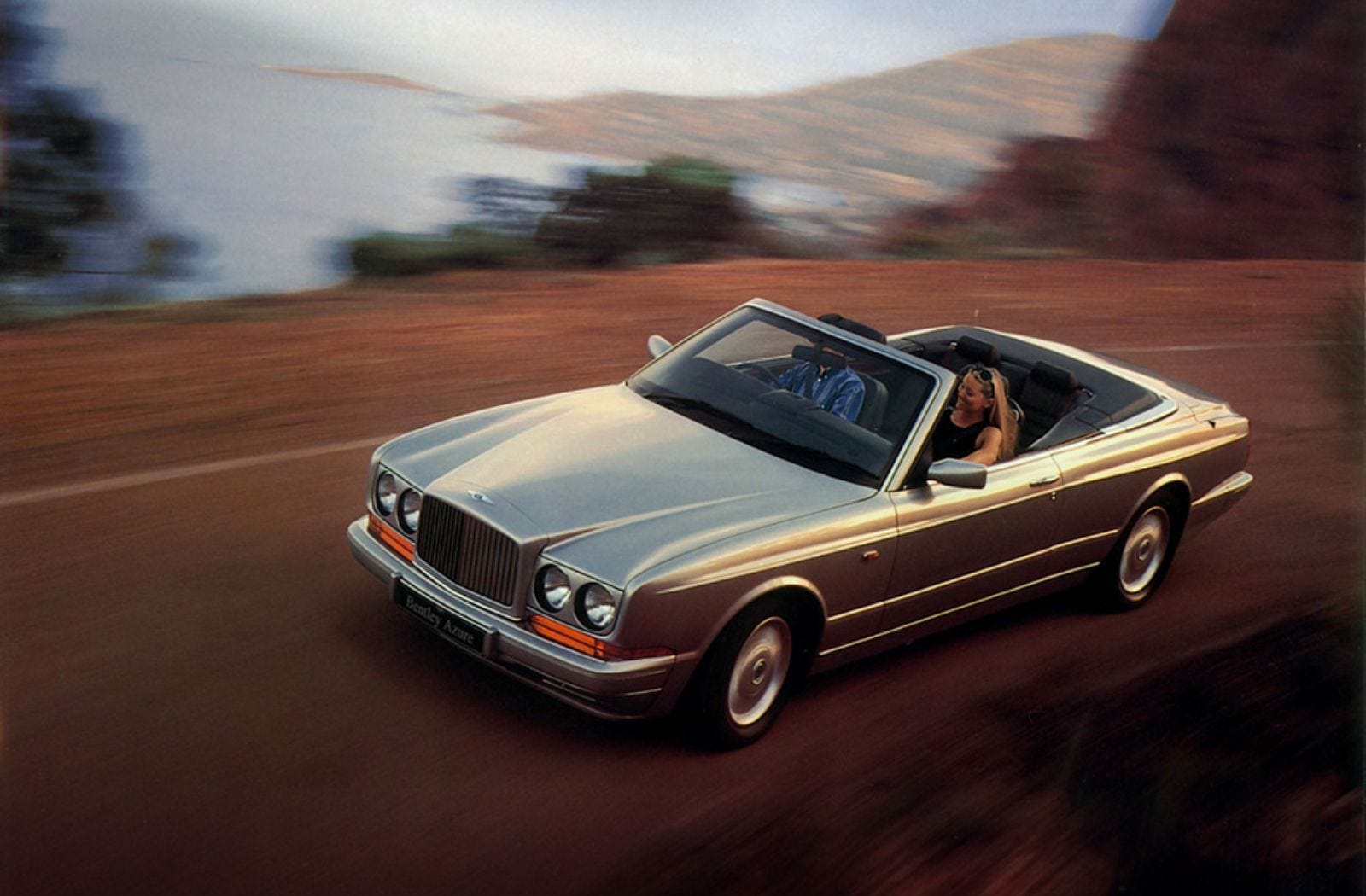
The Bentley Azure Mark I was not simply a convertible version of the Continental R. It was a statement car from the final old-world chapter of Crewe: huge, hand-finished, turbocharged, expensive, and almost defiantly traditional. Launched at the 1995 Geneva Motor Show, the Azure used the Continental R platform and turned Bentley’s big two-door coupé into a proper four-seat grand convertible.
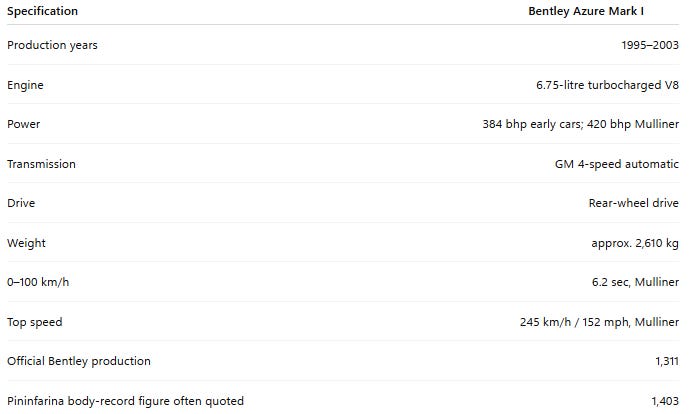
First-generation Azure remained in production from 1995 to 2003, with 1,311 built, although some Pininfarina body-production references quote 1,403 bodies.
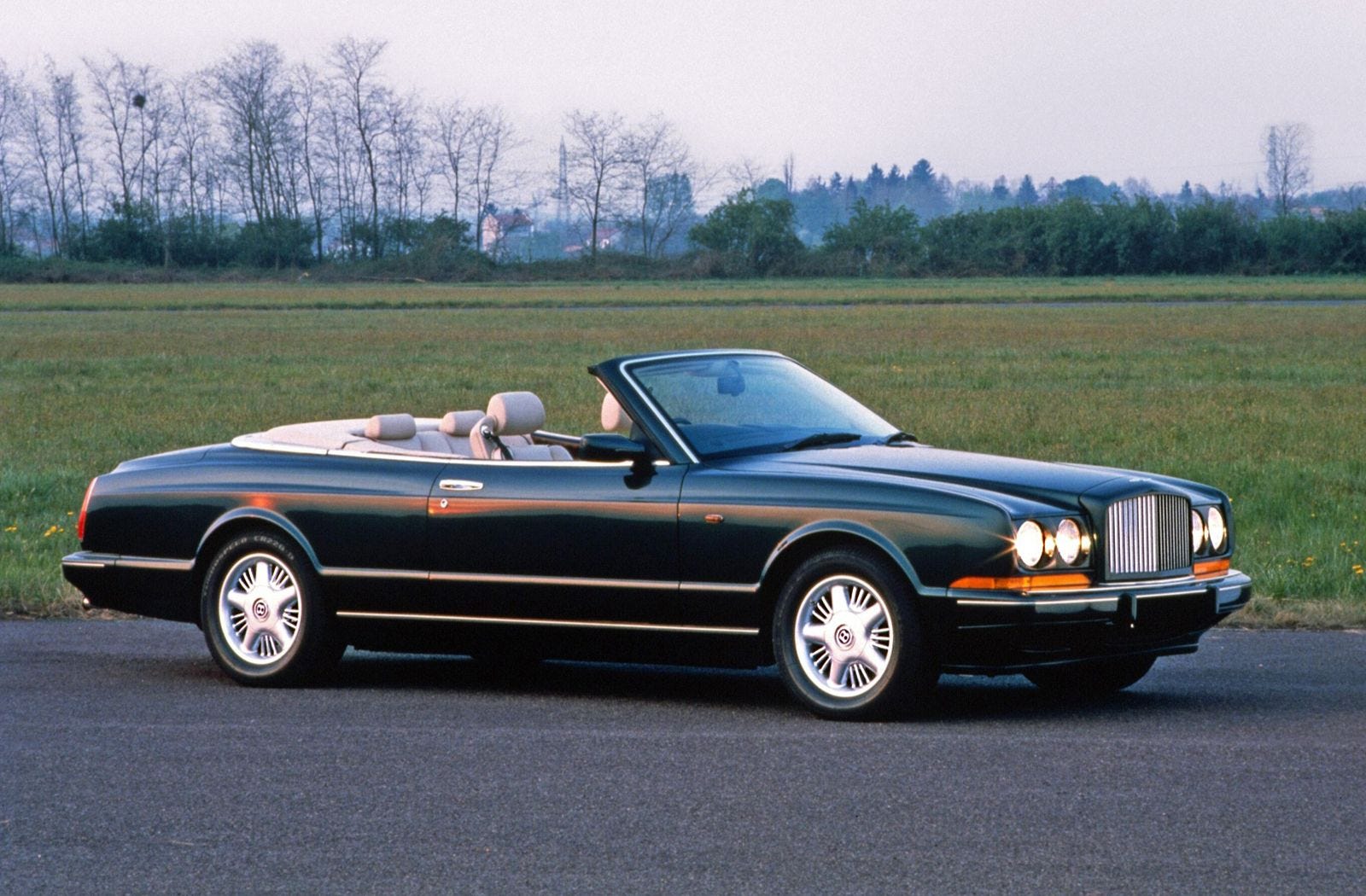
The Concept: A Bentley for the Côte d’Azur
The name “Azure” was perfectly chosen. This was not a sharp sports car for mountain passes; it was a Riviera express for Monaco, Palm Beach, Marbella, Beverly Hills, and Knightsbridge. It had the stance of a luxury yacht and the manners of an aristocratic muscle car.
Bentley had a problem in the mid-1990s: the old Continental convertible lineage had reached the end, but the Continental R had given the brand a modern grand-touring identity. The Azure became the open-top version of that identity. Bentley’s own heritage notes describe the Continental R as the new high-performance platform that allowed the company to replace the outgoing Continental convertible line.


Pininfarina’s Difficult Job
Turning a 5.35-metre Bentley coupé into a roofless four-seat convertible was not a simple styling exercise. The Continental R’s roof was structural, so the Azure needed serious reinforcement. Bentley states that 190 kg of stiffening material was added to the floor, sills, and windscreen structure to compensate for the missing roof. The bodyshells were assembled in Italy by Pininfarina, fitted with the power soft-top, painted, and then shipped back to Crewe for final finishing.
That Italian involvement gave the Azure a special place in Bentley history. It was not a Pininfarina design in the Ferrari sense, but it was very much a Pininfarina-engineered convertible body married to Crewe craftsmanship. The result was immense, elegant, slightly excessive, and completely unlike anything from Germany or Italy.
Engine and Performance
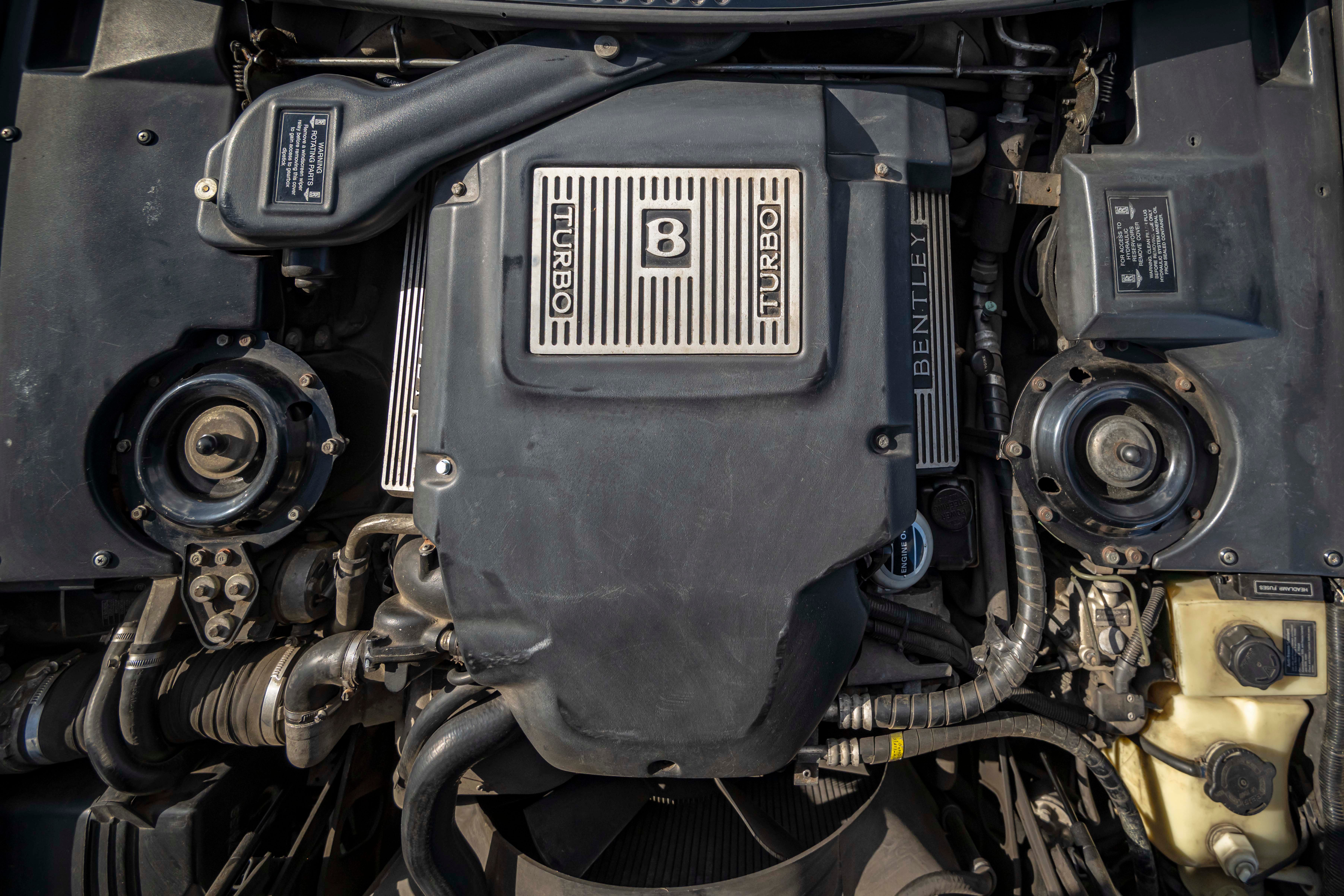
Under the bonnet sat Bentley’s legendary 6.75-litre turbocharged V8. Early cars produced around 384 bhp, with a governed top speed quoted by Bentley at 155 mph. Later Mulliner cars raised output to 420 bhp, with Bentley quoting 0–100 km/h in 6.2 seconds and a maximum speed of 152 mph / 245 km/h for the 2003 Azure Mulliner.
Key Specifications — Bentley Azure Mark I / Mulliner
The Mulliner Upgrade
From 1999, the Azure Mulliner became the more desirable version. It added more power, wider visual attitude, flared wheel arches, Mulliner badging, 18-inch five-spoke wheels, and a more individual specification process. Bentley’s Heritage Collection car is a 2003 Azure Mulliner Final Series Performance, and Bentley notes that only 62 Final Series Performance examples were built.
The Mulliner cars feel like the definitive Azure: more muscular, more collectible, and more aligned with the Bentley personality than the softer Rolls-Royce Corniche V.


Interior: Crewe at Its Most Indulgent
Inside, the Azure was pure old-school Bentley. Connolly hide, thick carpets, polished veneers, chrome details, and a dashboard that felt closer to a private club than a modern cockpit. The driving position was upright and commanding. The doors were long and heavy.


The Azure was technically a four-seater, and unlike many grand convertibles, adults could actually sit in the rear. This was one of its greatest strengths. A Mercedes SL600 was faster and more advanced, but it was fundamentally a two-seat roadster. The Bentley was a full-size open-top grand tourer.
Driving Character
The Azure was not about agility. It was about torque, silence, and presence. The 6.75-litre turbo V8 delivered its force in a deep, effortless wave. It did not ask to be revved; it simply moved the car forward with enormous authority.
The four-speed automatic suited the character. By sports-car standards, it was old-fashioned. By Bentley standards, it was appropriate. This was a car for crossing countries with the roof down, not chasing apexes. The reinforced body meant it was heavy, but the sheer torque made the Azure feel far quicker than its size suggested.
Period-Correct Competitor Comparison
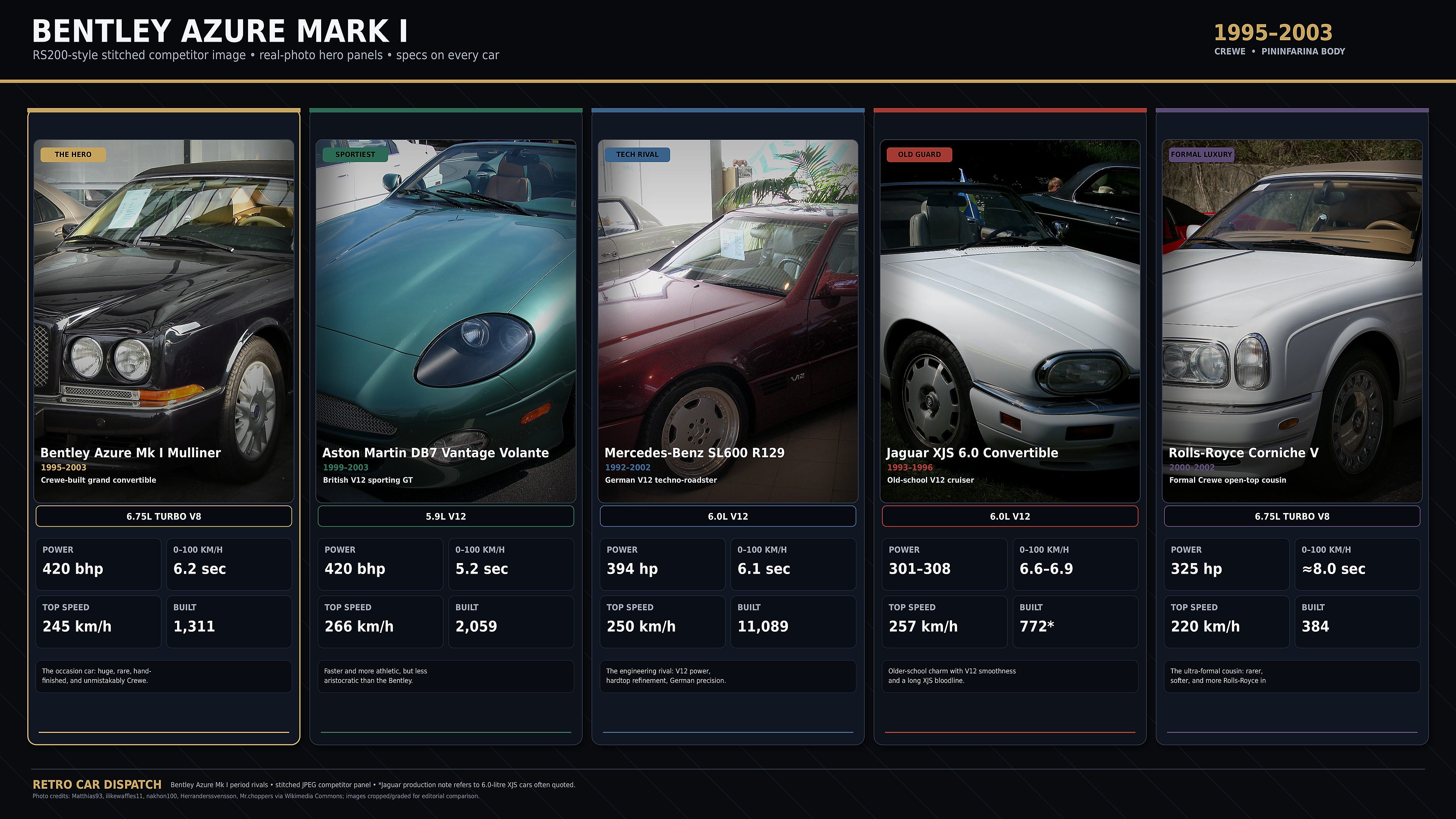
The comparison shows why the Azure was unique. The Aston was sportier, the Mercedes was more technically sophisticated, the Jaguar was older and more affordable, and the Corniche V was more formal. The Azure sat in the middle as the most Bentley-like proposition: a huge, turbocharged, hand-finished convertible with real rear seats and unmistakable road presence.
Relationship with the Rolls-Royce Corniche V
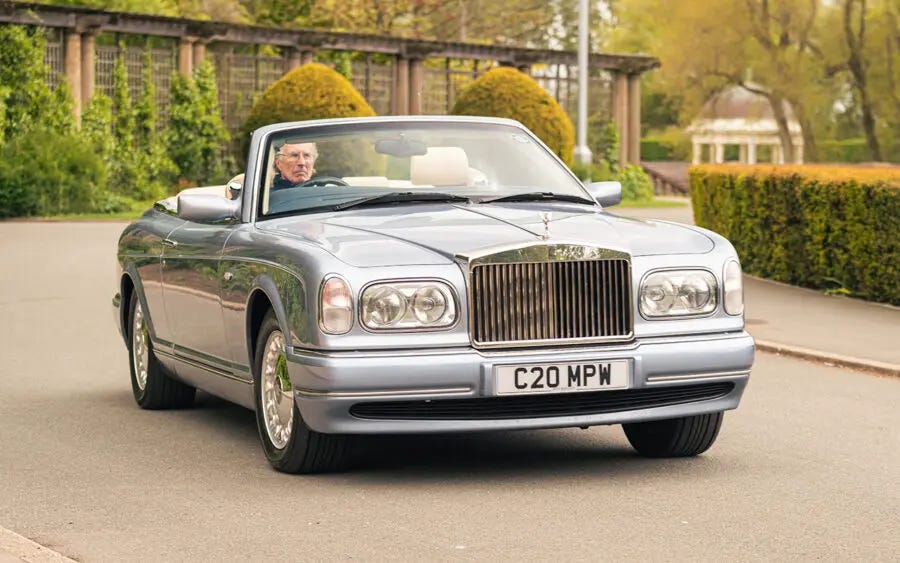
The Corniche V is often considered the Azure’s softer, more formal cousin. It used the same broad Crewe-era philosophy and related underpinnings, but with Rolls-Royce styling and a more relaxed 325 hp version of the 6.75-litre turbo V8. Only 384 Corniche V examples were produced, making it rarer than the Azure, but arguably less dynamically interesting.
Market and Collectability
For years, the Azure was undervalued because maintenance costs scared buyers away. That remains true: roof hydraulics, suspension systems, bespoke trim, electronics, and turbo V8 upkeep can become very expensive. But the market has started to understand what the car represents. Classic.com currently lists a market benchmark of around $59,117 for first-generation Azure cars, with an average sale price around $55,409, though exceptional low-mileage or Mulliner cars can sit much higher.
The cars to watch are late Mulliner examples, Final Series Performance cars, rare colours, low-mileage cars, and well-documented examples with proper specialist maintenance. A cheap Azure is usually the most expensive Azure in disguise.
Buying Notes
The Azure is not a casual classic purchase. A pre-purchase inspection by a Rolls-Royce/Bentley specialist is essential. The roof mechanism must work perfectly, the hydraulic systems should be dry and responsive, the suspension should not sag or behave unevenly, and the service history must show regular specialist care.
Interior condition also matters. Connolly leather, veneer, carpets, and trim can all be restored, but not cheaply. Because many cars were heavily personalised, colour combination plays a major role in value. Dark blue, green, black, silver, and elegant two-tone interiors tend to suit the car best.
Verdict
The Bentley Azure Mark I is one of the last true pre-modern Bentley grand tourers. It belongs to the era before the Continental GT transformed Bentley into a global performance-luxury powerhouse. It still carries the old Crewe DNA: hand-built charm, massive displacement, turbocharged torque, real wood, real leather, and the sense that the car was made for someone who did not need to explain the price.
It is not the sharpest, fastest, or most rational convertible of its period. That is exactly the point. The Azure Mark I is a rolling contradiction: aristocratic but muscular, elegant but excessive, Italian-assisted but deeply British. As a youngtimer-era flagship, it deserves far more respect than it received for many years.